Choosing a childcare cleaning provider in Sydney isn't just a facilities decision — it's a compliance decision. A centre director who books the wrong contractor inherits the risk at their next assessment and rating visit. Most childcare cleaning Sydney listings talk about mopping and rubbish removal and stop there; almost none mention the standard your service is actually assessed against. The sections below cover the National Quality Standard, the Education and Care Services National Regulations, and the day-to-day hygiene protocols that a genuine childcare centre cleaning partner needs to understand, so you can brief — or vet — a cleaning team with confidence.
NQS Quality Area 2: Children’s Health and Safety
Quality Area 2 of the National Quality Standard is titled Children’s Health and Safety, and it is administered nationally by ACECQA (the Australian Children’s Education and Care Quality Authority). Standard 2.1 deals specifically with health, and element 2.1.2, "health practices and procedures," requires that effective illness and injury management and hygiene practices are promoted and implemented across the service.
In practice, an assessor looking at QA2 wants to see documented, followed hygiene routines — not just a clean-looking room on the day of the visit. That means a childcare centre cleaning schedule, product list, and sanitising log that a director can point to as evidence, alongside the educators’ own hand hygiene and food safety practices. A cleaning contractor who understands QA2 will work to a routine that supports your rating, not just a mop-and-go visit that leaves you to explain the gap yourself.
This matters because a service’s rating against the NQS is public — families compare it when choosing a centre, and a director doesn’t want cleaning to be the weak link in an otherwise strong assessment. Treating the cleaning contract as part of your QA2 evidence, rather than a background facilities cost, is the difference between a routine that helps your rating and one you simply hope nobody looks at too closely.
Education and Care Services National Regulations
Beneath the NQS sits the Education and Care Services National Regulations 2011, which set out specific, checkable requirements for the physical environment and daily practices of a service. Several of these regulations sit directly in a cleaning contractor’s lane:
- Regulation 77 — health, hygiene and safe food practices, covering the day-to-day routines a service must have in place to minimise the spread of infectious illness and handle food safely.
- Regulation 103 — requires premises, furniture and equipment to be safe, clean and in good repair at all times, not just during an inspection.
- Regulation 104 — fencing and security around outdoor areas, which affects how outdoor equipment and surfaces are accessed and cleaned.
- Regulation 105 — furniture, materials and equipment must be suitable, sufficient and safe for the children using the service.
- Regulation 106 — laundry and hygiene facilities, covering how soiled linen, clothing and bedding are handled and stored on site.
- Regulation 109 — toilet and hygiene facilities must be adequate, age-appropriate and accessible for the children enrolled.
WWCC-Cleared and Police-Checked Cleaning Teams
None of the regulations above are written with a cleaning company specifically in mind — they’re written for the approved provider, who carries the compliance obligation regardless of who does the physical work. That’s exactly why the choice of contractor matters: if a cleaner doesn’t understand what regulations 77, 103, 105, 106 and 109 actually require, the director is the one left explaining the gap to an authorised officer at the next assessment, not the cleaner.
Anyone attending a childcare centre in NSW during operating hours, including a contractor, also needs to be screened to a standard the sector actually requires. A Working With Children Check (WWCC), issued under the Child Protection (Working with Children) Act 2012 (NSW) and administered by the Office of the Children’s Guardian, is a specific background check for people working with children — it is not the same thing as a standard police check.
A police check is a point-in-time snapshot of criminal history. A WWCC goes further: it screens against a wider set of relevant records and, once issued, the holder is subject to ongoing monitoring for the life of the clearance, so a director doesn’t need to re-verify it every visit. Ever Clean’s team is WWCC-cleared and police-checked, and the business carries $20M public liability insurance — the combination a centre director should be asking for before anyone from a cleaning company is on site.
Nappy Change Area and Bathroom Protocol
Nappy change areas and bathrooms are the highest cross-contamination risk in any childcare centre, which is why they need their own cleaning protocol rather than being folded into a general "bathroom clean." A compliant routine covers the change mat and surrounding bench surface, taps and handles, nappy bin exterior, and floor, cleaned and sanitised between sessions, not just once at the end of the day.
Toilet and hygiene facilities under the National Regulations need to stay genuinely accessible and hygienic for the age groups enrolled, which means low-height fixtures, step stools and shared taps all need to be part of the routine — areas a generic office cleaning checklist typically misses entirely.
This is one of the clearest examples of why "child care cleaning" and standard commercial cleaning aren’t interchangeable services. An office cleaner rotating through a building at 6pm has no reason to think about a change mat surface between individual nappy changes; a childcare cleaning team should be building the whole visit around that risk.
Sleep and Rest Mat Sanitising
Rest and sleep areas sit under the same health and hygiene expectations as the rest of the centre, and mats, cots and bedding are handled by multiple children across a week, so they need a defined sanitising cycle rather than an occasional wipe-down. Mats should be wiped and sanitised after each use where illness has occurred, and on a set schedule otherwise, with linen laundered separately from general cleaning cloths.
A childcare cleaning provider should be able to tell you, without hesitation, how often mats are sanitised, what product is used, and how that’s recorded — because this is exactly the kind of detail an assessor or a concerned parent will ask a director about directly. It also needs to hold up across a full room of mats, not just a sample — a stack of forty rest mats sanitised inconsistently is still a hygiene gap, even if most of them were done properly.
Outbreak Response: Gastro and Hand, Foot and Mouth Disease
Gastroenteritis and hand, foot and mouth disease move fast through a childcare centre because they spread through contact with contaminated surfaces as well as person-to-person, and a standard weekly clean isn’t built to contain either one. When a centre reports a case, the cleaning response needs to change immediately, not at the next scheduled visit.
A director dealing with an active outbreak doesn’t have time to negotiate a scope change with their cleaner — the response plan needs to already exist, agreed in advance, so the extra visit or extended scope can be actioned with a phone call rather than a fresh quote.
- Increased frequency on high-touch surfaces — door handles, taps, light switches, toys and shared equipment.
- Hospital-grade disinfection of bathrooms, nappy change areas and any surface a symptomatic child has been in contact with.
- Separate cloths and equipment for affected rooms, to stop the outbreak spreading to unaffected age groups.
- A follow-up deep clean once the outbreak has cleared, rather than reverting straight back to the standard routine.
Colour-Coded Microfibre and TGA-Listed Disinfectants
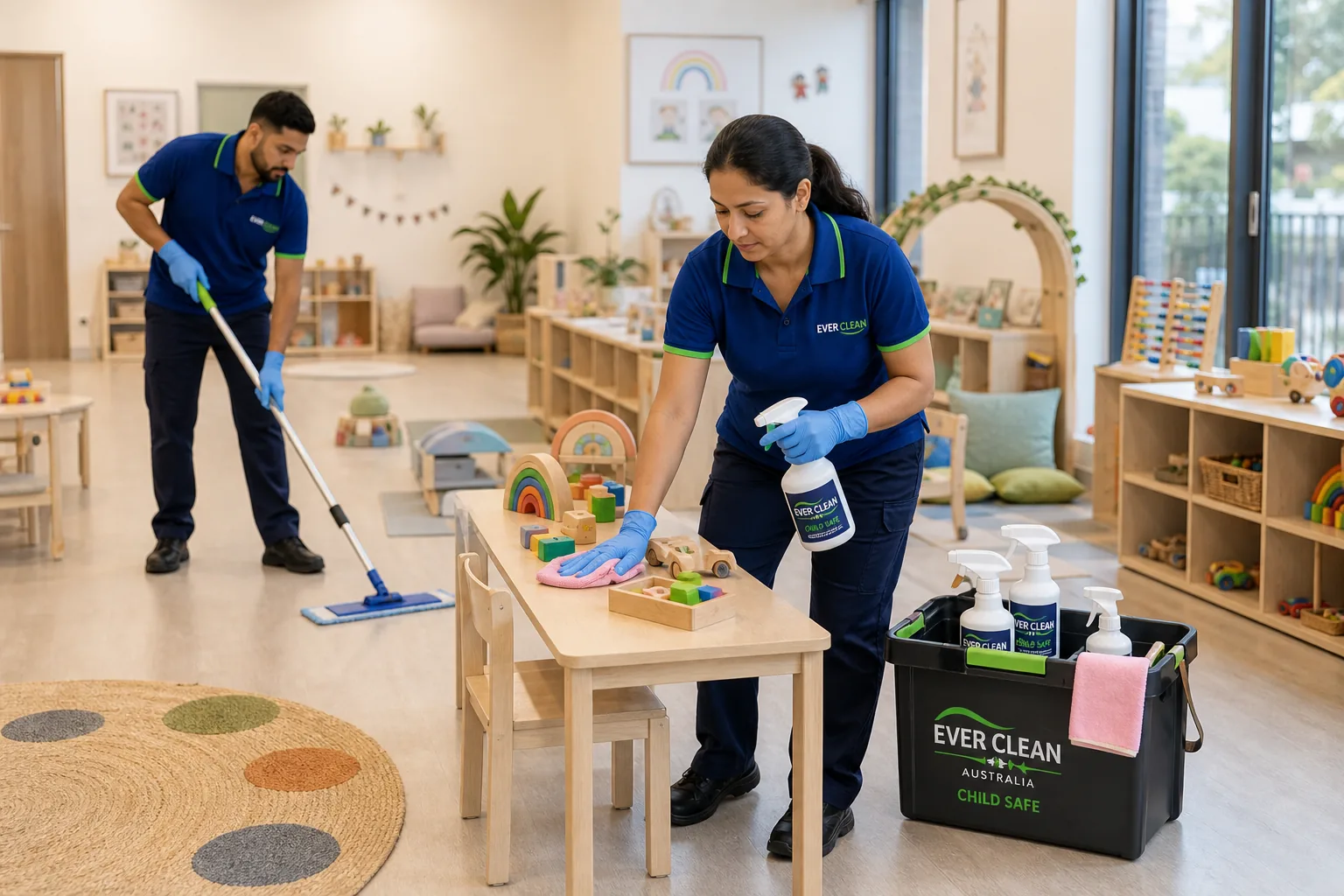
Cross-contamination control starts with the equipment, not the chemical. A colour-coded microfibre system — separate cloth and mop colours for bathrooms, nappy change areas, kitchens and general classroom surfaces — stops bacteria being carried from a bathroom into a room where children eat or play, which is the single biggest hygiene failure in centres that use a one-cloth-does-everything approach.
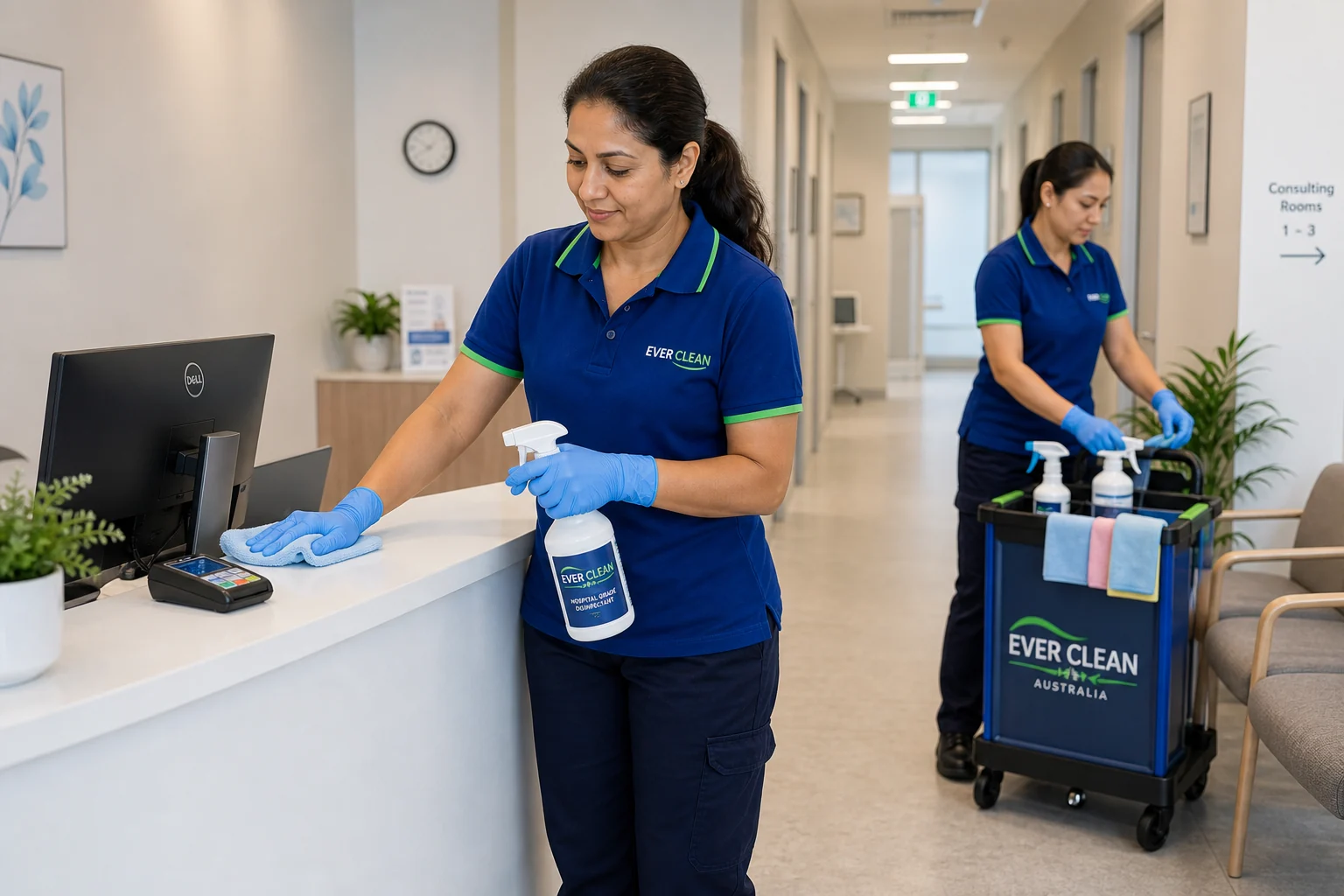
On top of that, disinfectants used in a childcare setting should be TGA-listed hospital-grade products, used at the correct dilution and contact time for the surface — not a generic supermarket spray. Contact time matters as much as the product itself: a disinfectant wiped off before it has sat on the surface for its stated dwell time hasn’t actually disinfected anything, it’s just left a surface that looks clean.
Ever Clean has provided childcare centre cleaning across Sydney since 2018 and builds every routine around this colour-coded, TGA-listed standard as the baseline, not an upsell.
What Childcare Cleaning Costs in Sydney
Pricing for daycare cleaning services Sydney-wide varies depending on centre size, frequency, and whether nappy change and food prep areas need a higher-frequency routine than the rest of the floor plan. As a general guide, published childcare cleaning rates sit in the $45–$65 per hour band, with most centres booking on a fixed per-visit rate rather than paying hourly once a regular schedule is agreed.
- Hourly rate: $45–$65 per hour for childcare cleaning.
- Per-visit rate: $180–$480 for a childcare or early learning centre clean, depending on size and scope.
Ever Clean Australia is based at 54 Columbia Rd, Seven Hills NSW 2147, and has provided child care cleaning to centres across Sydney since 2018 with a fully WWCC-cleared, police-checked team. For a free, no-obligation quote on your centre, call 0485 017 800.