Warehouse cleaning Sydney facilities need is not the same job as an office clean after hours. A distribution centre, cold-store or 3PL floor is a live operational environment with forklifts, pallet jacks, racking, dock levellers and shift workers moving through it — often while our crews are on site. The detail below sets out how our warehouse cleaners approach the work health and safety, dust and hygiene obligations that come with cleaning around live industrial and logistics operations, so a facilities or operations manager can see exactly what a compliant warehouse clean actually involves before we quote.
Shared duty of care under the Work Health and Safety Act
Under the Work Health and Safety Act 2011 (NSW), the person conducting a business or undertaking (PCBU) operating a warehouse and the cleaning contractor working inside it both carry duties for the health and safety of everyone on site — including each other's workers. A cleaning crew is not exempt from site rules simply because it is a subcontractor; it becomes part of the site's risk picture the moment it steps onto the floor.
In practice that means every warehouse cleaning engagement starts with a proper site induction, not a five-minute walk-through. Our teams confirm PPE requirements, high-visibility clothing rules, emergency assembly points, restricted zones and any site-specific hazards before a mop or scrubber touches the floor. For larger or higher-risk sites we work from a Safe Work Method Statement (SWMS) covering the cleaning tasks involved, reviewed against the site's own risk assessments so there is no gap between what the warehouse expects and what our crew actually does.
This is the difference between a domestic-style clean scaled up and genuine industrial cleaning Sydney operators can rely on: a cleaner working a live distribution floor needs to understand traffic flow, hazard interfaces and reporting lines, not just have a mop and bucket.
- Site-specific induction before any works commence
- SWMS aligned to the site's own risk assessments on larger sites
- Clear incident and hazard reporting back to site management
- PPE and high-visibility compliance matched to the site's rules
Forklift-safe scheduling, traffic management and dock levellers
The single biggest risk on most warehouse floors is the interaction between pedestrians and materials handling equipment. Forklifts, reach trucks and pallet jacks have limited sightlines and long stopping distances, and a cleaner backing a scrubber out of an aisle is exactly the kind of pedestrian-plant interaction that site traffic management plans exist to prevent.
Where possible we schedule warehouse cleaning Sydney-wide around low-traffic windows — early mornings, evening shift changeovers or planned operational lulls — so racking aisles and dock areas are being cleaned when forklift movement is lightest. Where a live clean during operating hours is unavoidable, we work inside the site's existing traffic management plan: staying within marked pedestrian walkways, using witches hats or barriers to mark out a temporary exclusion zone around active cleaning, and using a spotter for any task near a blind corner, dock leveller or forklift charging bay.
Loading docks carry their own specific hazards — dock levellers that can shift underfoot, trailers reversing in and out, and the crush zone between a stationary trailer and the dock edge. We treat dock apron and leveller cleaning as its own task with its own checks, never as an extension of general floor cleaning, and we do not clean a leveller or dock plate while a trailer is docking or undocking.
- Cleaning scheduled around low-traffic and shift-change windows where possible
- Temporary exclusion zones and signage for cleaning in live aisles
- Spotters used near blind corners and forklift charging areas
- Dock leveller and apron areas cleaned only when trailers are not docking
Racking dusting, high-level access and working at heights
High-bay racking accumulates dust on beams, ledges and the tops of stock in a way that a ground-level clean never touches — and that dust is not just a housekeeping issue. Accumulated dust on racking is a genuine fire load, and in food-grade or fine-goods storage it is also a stock contamination risk that a client's own auditor will look for.
Where racking dusting requires access above safe reach-and-pole height, our crews use an elevated work platform (EWP) or scissor lift rather than improvising with ladders in an active racking aisle. Working at heights around racking brings its own hazards on top of the usual fall risk — overhead beams, sprinkler heads, pallet loads on the level above and restricted headroom — so any high-level access work is planned with the site beforehand, including confirming the aisle is locked out to forklift traffic while the platform is in use.
For lower-level racking, uprights, guarding and beam faces, we work these into the regular factory cleaning and warehouse cleaning services schedule rather than treating them as a one-off, since dust and cobweb build-up on racking is continuous, not seasonal.
- EWP or scissor lift used for high-bay racking access, not ladders
- Aisle locked out to forklift movement during elevated work
- Racking dust treated as a fire-load and contamination risk, not just tidiness
- Beam, ledge and upright dusting scheduled as a recurring task
Silica dust and hazardous dust control
Facilities that share space with concrete cutting, masonry work or nearby construction — or that simply have exposed, ageing concrete floors — can generate respirable crystalline silica dust. This is a recognised occupational health hazard, and SafeWork NSW guidance is clear that hazardous dusts should not be managed by dry sweeping, which lifts fine particles into the air rather than removing them.
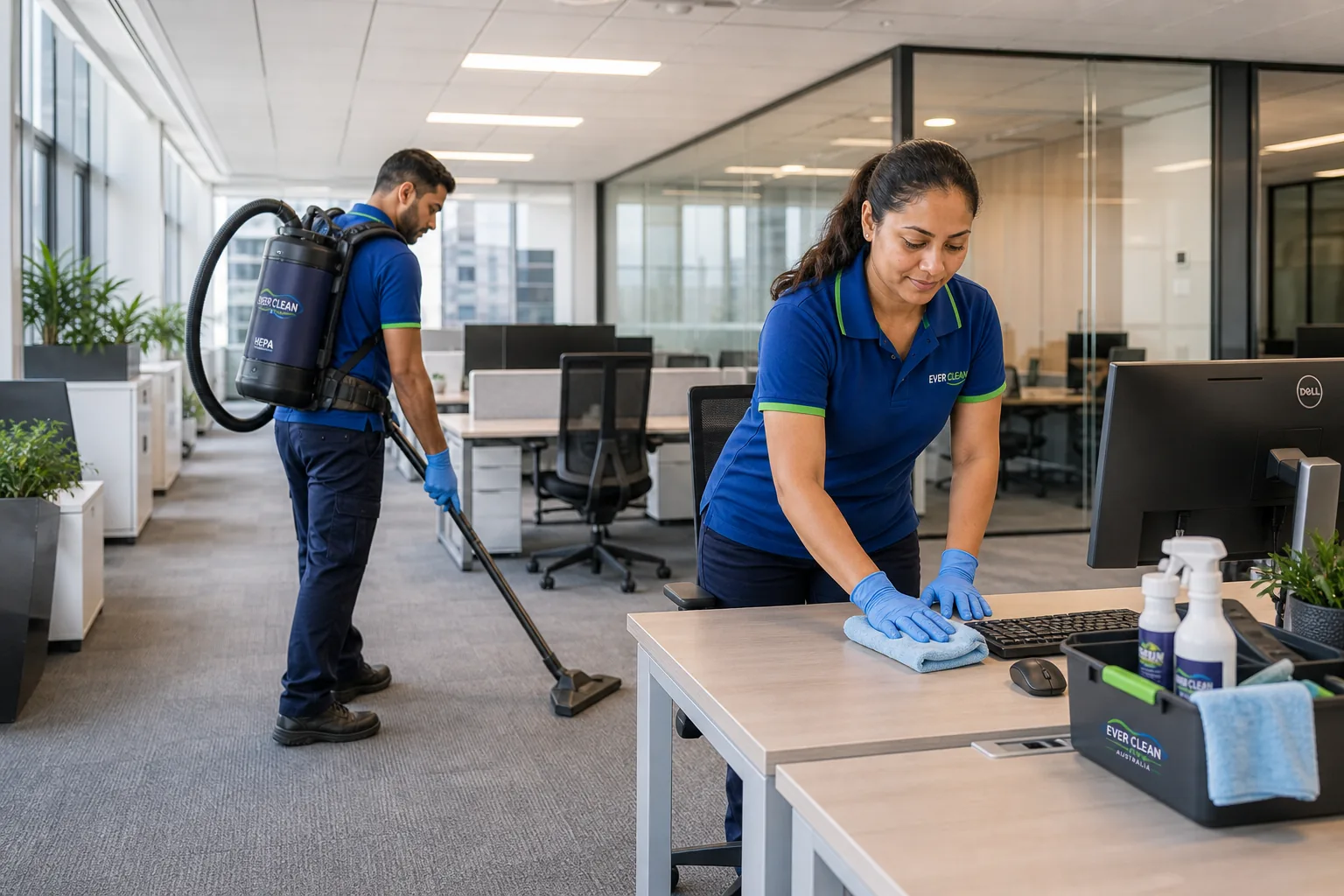
Our approach on any site where hazardous or fine dust is a possibility is HEPA-filtered vacuum extraction rather than a dry broom, so dust is captured at the point of collection instead of being redistributed across the floor and into the air the workforce breathes. Where a facility is directly adjacent to cutting, grinding or demolition activity, we discuss dust risk with the site beforehand and adjust our method and PPE accordingly rather than treating it as a standard sweep-and-mop job.
This same principle carries through to general warehouse cleaners Sydney businesses engage for ongoing floor care: fine dust control is a health control, not a presentation choice, and it shapes the equipment we bring to site as much as the schedule we work to.
- HEPA vacuum extraction used in preference to dry sweeping for fine dust
- Dust risk discussed with the site where cutting or grinding activity is nearby
- PPE and method adjusted for hazardous dust environments
- Aligned with SafeWork NSW guidance against dry sweeping of hazardous dusts
Epoxy and concrete floor scrubbing
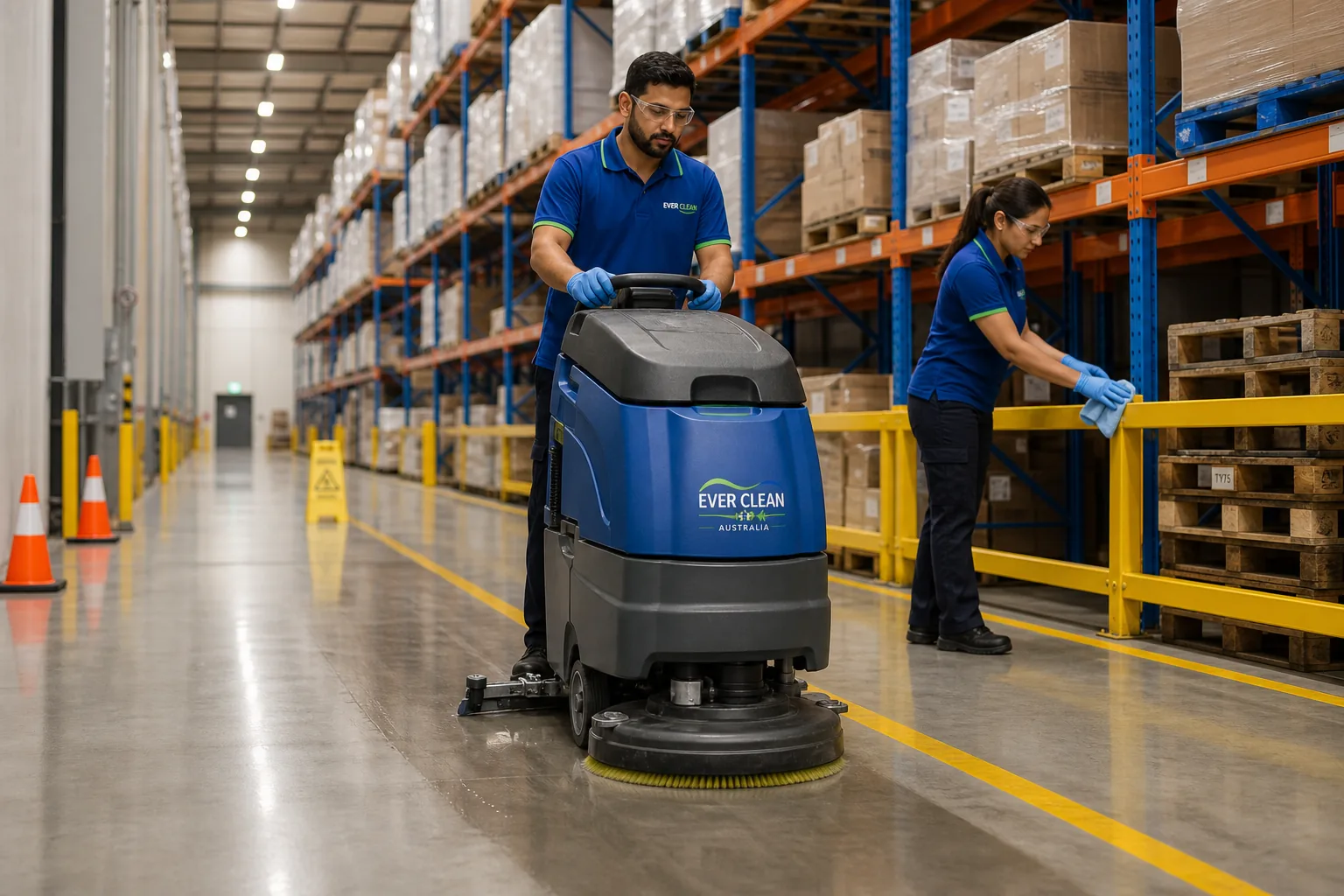
Warehouse floors are usually sealed concrete or epoxy-coated, and both surfaces need a different approach to an office or retail floor. We use ride-on and walk-behind auto-scrubbers sized to the floor plate, running the correct pad and detergent combination for the coating so the clean lifts grime, oil and tyre marks without cutting into the epoxy finish or dulling a sealed concrete surface over time.
Line marking — pedestrian walkways, racking bay numbers, forklift lanes and hazard zones — is part of the floor, not separate from it, so our scrubbing method is chosen to preserve painted lines rather than wear through them pass after pass. The same goes for the non-slip surface itself: aggressive pads or the wrong chemical mix can strip the texture that keeps a floor safe underfoot, so we match the pad grade to the coating rather than defaulting to the heaviest option available.
Oil drips, tyre marks and general vehicle staining around forklift lanes and dock areas get targeted spot treatment as part of the same visit, since these are the marks a site manager and any visiting client notice first.
- Ride-on and walk-behind scrubbers matched to floor size and coating type
- Line marking and hazard zone paint preserved, not worn through
- Pad and chemical selection matched to the floor to protect the non-slip surface
- Oil and tyre-mark spot treatment included in the scrubbing visit
Food-grade and HACCP warehouse cleaning
Third-party logistics operators, food distributors and cold-chain warehouses are increasingly held to food-grade cleaning standards by their own customers, even where the warehouse itself is not a food manufacturing site. Our crews clean to the food-grade and HACCP-aligned requirements a client site sets — we do not hold HACCP certification ourselves, and we are upfront about that, but we work to the standard the site's own food safety plan requires rather than a generic industrial clean.
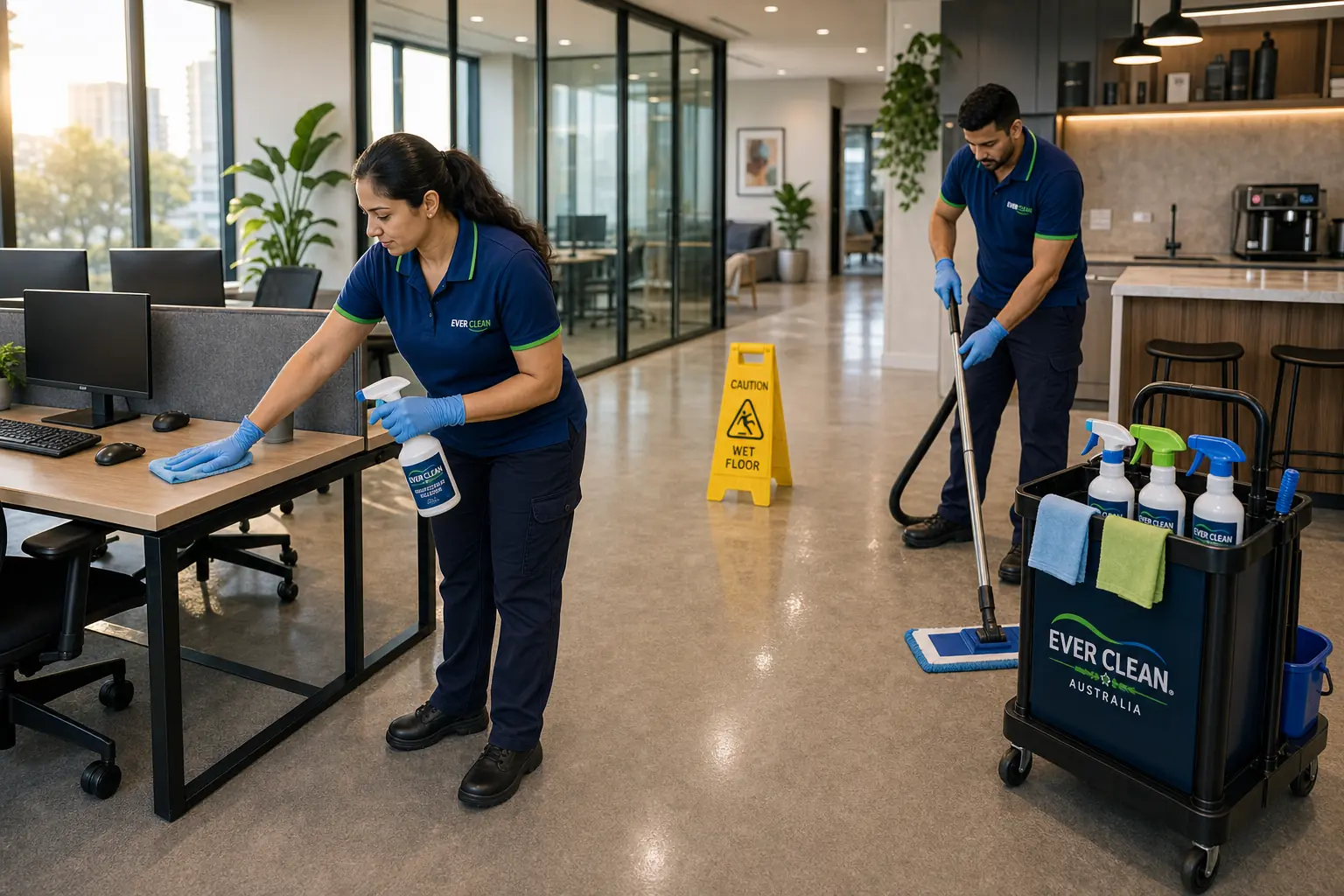
In practice that means colour-coded equipment and cloths to prevent cross-contamination between zones, cleaning chemicals and methods chosen with allergen control in mind, and a clear interface with the site's pest management program so cleaning does not undermine bait station placement or exclusion measures. Where a client's food safety plan calls for it, we complete cleaning records and checklists that a site can hold on file for its own audits.
This is the standard a food-grade 3PL client will actually check: not just a clean-looking floor, but colour-coded systems, documented records, and a cleaning contractor who understands where cleaning stops and the site's own food safety controls begin.
- Cleaning performed to the client site's own food-grade/HACCP requirements
- Colour-coded equipment to prevent cross-contamination between zones
- Chemical and method selection with allergen control in mind
- Cleaning records and checklists provided where a client's food safety plan requires them
- Coordinated with, not overlapping, the site's pest management program
Ever Clean Australia has been servicing Sydney warehouses and distribution facilities since 2018 with police-checked staff and $20 million public liability cover — get in touch for a free warehouse cleaning quote on 0485 017 800.