Medical centre cleaning in Sydney sits inside a framework of infection prevention expectations that general practice accreditation is built around. The sections below set out what an accreditation surveyor typically looks for in a practice’s cleaning arrangements, how professional environmental cleaning supports (without replacing) clinical infection control, and where the boundary sits between what a contracted cleaner does and what remains the responsibility of practice and clinical staff.
RACGP Standards and Infection Prevention Expectations
Australian general practices seeking or maintaining accreditation are assessed against the RACGP Standards for general practices, which set out expectations for infection prevention and control across the whole practice environment — not just clinical procedure rooms. Cleanliness and hygiene of the physical premises is treated as part of a practice’s overall risk management, alongside things like waste handling, hand hygiene facilities, and staff training records.
When a surveyor reviews a practice’s infection control arrangements, cleaning is rarely assessed in isolation from documentation. What tends to matter is whether the practice can demonstrate a regular, documented cleaning schedule; whether cleaning records exist showing what was done and when; whether cleaning staff have received appropriate training in infection control basics for a healthcare setting; and whether clean and dirty workflows are kept separate — for example, not using the same cloths or mop heads across a treatment room and a public toilet, and not carrying waste back through clean corridors.
A contracted commercial cleaner is not the practice’s infection control coordinator and does not sign off on accreditation — that responsibility sits with the practice itself. What a reliable medical centre cleaning provider can offer is the evidence trail that supports it: a written cleaning schedule specific to the practice, visit logs and service records the practice can produce at an accreditation visit, and cleaning staff briefed on colour-coded equipment and clean/dirty separation so the practice is not relying on generic office-cleaning habits inside a clinical environment.
- Documented, practice-specific cleaning schedule
- Cleaning records and visit logs available on request
- Cleaning staff trained in basic healthcare infection control practice
- Separate equipment and workflows for clean and dirty areas
AS/NZS 4187 and Cleaning Around Reprocessing Areas
AS/NZS 4187 is the Australian and New Zealand standard governing the reprocessing of reusable medical devices in health service organisations — the sterilisation and disinfection of instruments used in minor procedures, for example. Reprocessing itself is a clinical function performed by trained practice or clinical staff using validated equipment and processes; it is not something a commercial cleaning contractor performs, and Ever Clean does not undertake instrument reprocessing under any circumstances.
Where professional cleaning contributes is the environment around a reprocessing area, not the reprocessing itself. A room used for instrument reprocessing needs its surfaces, floors, sinks and fixtures kept genuinely clean as part of the broader environmental controls that support a compliant reprocessing workflow — dust, grime and surface contamination in the surrounding space work against the same infection control goals the reprocessing standard exists to protect. Our role in these areas is confined to general environmental cleaning: surface wiping, floor cleaning, and rubbish removal to a schedule and specification agreed with the practice, carried out around the reprocessing area rather than inside its validated workflow.
Any practice with a dedicated reprocessing room should treat its reprocessing procedures, equipment validation and staff competency as matters for its own clinical governance and, where needed, specialist sterilising services advice — a cleaning contractor’s scope stops at general environmental cleaning of the space.
TGA-Listed Hospital-Grade Disinfectants
In Australia, disinfectant products intended for use in clinical and healthcare settings are regulated by the Therapeutic Goods Administration (TGA) and must be listed on the Australian Register of Therapeutic Goods before they can be supplied for that purpose. A TGA listing is a property of the product itself — it confirms the disinfectant has been formulated and registered to meet the claims made about it, such as being effective against particular classes of bacteria or viruses. It is not a certification held by the cleaning company using the product, and Ever Clean does not claim TGA registration or clinical accreditation as a business — we use TGA-listed hospital-grade disinfectant products as part of our medical centre cleaning service.
The term "hospital grade" refers to a disinfectant’s tested efficacy against a broader range of microorganisms than a standard household or general commercial cleaning product, and this only holds true when the product is used as directed. Contact or dwell time — how long the disinfectant needs to remain wet on a surface before being wiped — is central to that efficacy; wiping a surface dry too early is one of the most common ways a disinfection step fails to achieve what the label claims, even with the right product.
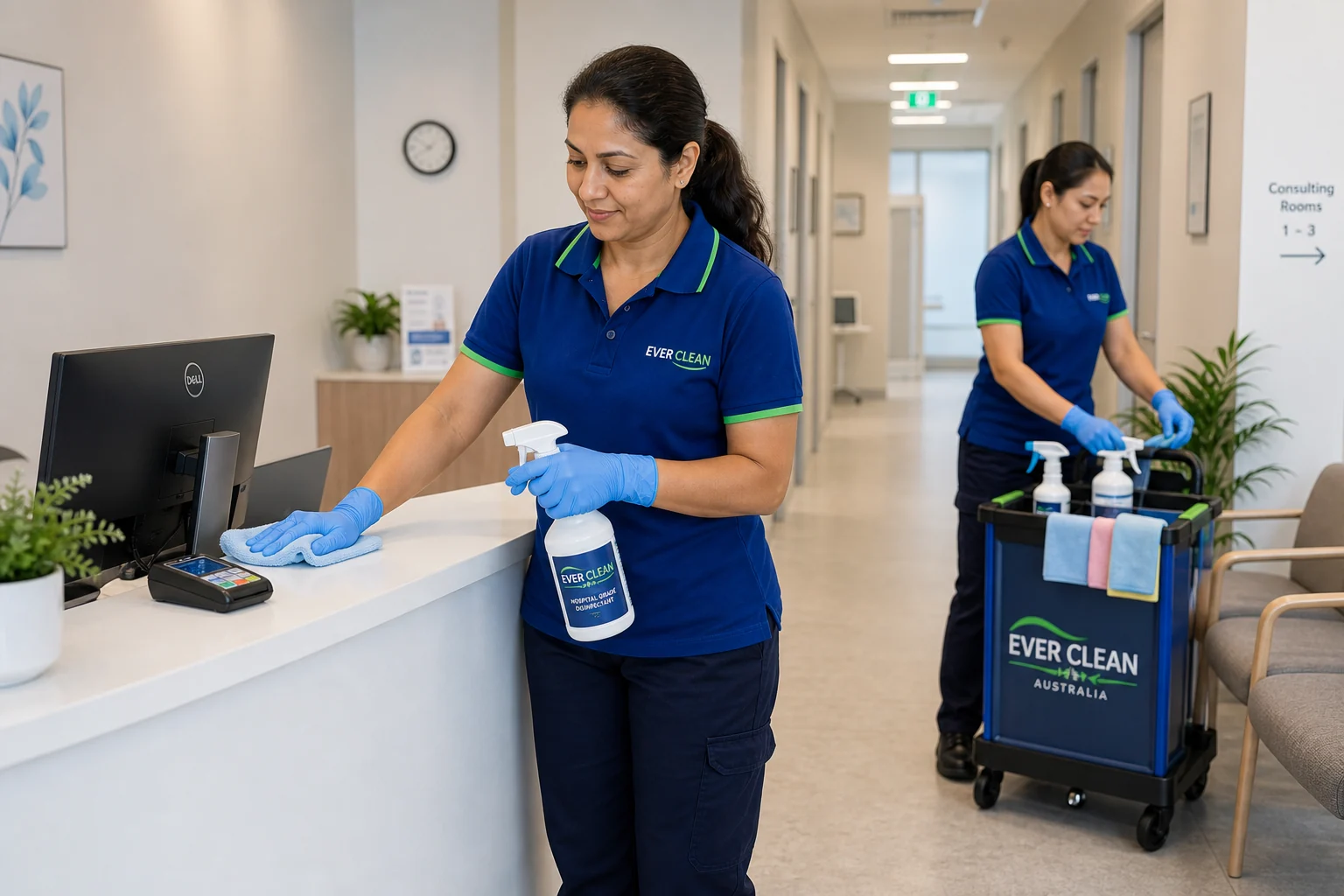
Cleaning and disinfection are related but distinct steps. Cleaning physically removes dirt, dust and organic material from a surface using detergent and water or a cleaning wipe. Disinfection uses a chemical product to reduce the number of microorganisms on a surface, and is only genuinely effective on a surface that has already been cleaned — disinfecting over visible grime or organic matter does not reliably work. Our medical centre cleaning teams are briefed to clean high-touch and clinical-adjacent surfaces before disinfecting them, and to observe correct dwell times, rather than treating disinfection as a single quick wipe.
Clinical Waste and Sharps: Where the Cleaner’s Role Ends
Medical centres generate two distinct waste streams, and keeping them separate is a basic infection control expectation as well as a workplace safety issue. General waste — packaging, paper, kitchen and office rubbish — is handled as part of standard commercial cleaning. Clinical waste, including anything contaminated with blood or bodily fluids, is a separate, typically colour-coded stream (commonly yellow bags or bins) collected under the practice’s own clinical waste contract, not by the general cleaning contractor.
Sharps containers are a firm boundary. Handling, closing, sealing and replacing sharps containers is the responsibility of clinical staff, not the cleaning team — our cleaners do not open, empty or manipulate sharps containers under any circumstances. If a cleaner finds a stray sharp outside a designated container during a clean, standard safe practice is to not touch it directly, to secure the area, and to notify practice staff immediately so it can be dealt with using proper clinical protocols and PPE. This boundary exists to protect both cleaning staff and the practice, and it is one we are explicit with clients about at the start of every medical centre contract.
- General waste and clinical (colour-coded) waste kept in separate streams
- Sharps containers handled only by clinical staff, never by cleaners
- A stray sharp found during cleaning is reported, not handled, by cleaning staff
- Waste handling scope confirmed in writing before a contract starts
Treatment Room Turnaround Between Patients
Turning a treatment or consulting room around between patients is largely a clinical task, not a contracted cleaning one — practice nurses or clinical staff typically wipe down the examination couch, change couch paper, and manage any immediate spill or contamination between individual appointments, because that turnaround needs to happen in the minutes between patients, not on a scheduled cleaning visit.
Where our medical centre cleaning service fits is the broader, scheduled clean of these rooms outside consultation hours — high-touch surfaces such as door handles, light switches, examination couch frames and armrests, taps and dispensers; floor cleaning and, where applicable, disinfection; and the general presentation of the room. Privacy curtains and screens are changed or laundered on a scheduled basis as agreed with the practice, since fabric curtains can hold contamination longer than hard surfaces and need a defined replacement cycle rather than an ad-hoc one. We work with each practice to agree exactly where clinical staff turnaround ends and our scheduled clean begins, so nothing falls through the gap between the two.
After-Hours and Weekend Access for Medical Practices
Many medical centres run extended hours, weekend clinics or after-hours urgent care, which makes cleaning access a genuine scheduling problem rather than an afterthought. We work with each practice to build a cleaning schedule around its actual opening hours — early morning, late evening or weekend visits where needed — rather than defaulting to a standard business-hours slot that clashes with patients.
Where a practice provides after-hours access, key and alarm protocols are agreed and documented in advance: who holds keys or access codes, how alarm activation and deactivation is handled, and what happens if a cleaner needs to raise an issue outside opening hours. Cleaning staff working in a medical centre will inevitably be in proximity to patient records, appointment screens and other information a patient would reasonably expect to stay private, even without directly handling that information. Our staff are briefed on confidentiality expectations specific to a healthcare environment — not viewing, discussing or photographing anything of that nature, and treating any incidentally observed information as strictly confidential — as a standard part of onboarding onto a medical centre contract.
Ever Clean Australia provides medical centre cleaning, clinic cleaning and infection control cleaning for GP practices and healthcare services across Sydney, using TGA-listed hospital-grade disinfectant products, police-checked staff and $20M public liability insurance, operating since 2018 from Wentworthville — get in touch for a free quote on 0485 017 800.